Default pick
Claude Opus 5
New Max default, strongest Pro option. API: claude-opus-5. List price $5 / $25 per MTok — half of Fable — while CursorBench nearly matches the peak.
Plain-language compare · Data from Anthropic
In one line: use Opus 5 every day; reach for Fable 5 only when you need the absolute peak. Opus 5 (Jul 24, 2026) is positioned as near-Fable intelligence at about half the price — the everyday default. Fable 5 remains the pricier peak option in the public Claude stack. Below we unpack pricing and official charts.
Bottom line
You don’t need every benchmark name. Ask two questions: will you run this every day? Is failure so costly that the last 0.5% is worth double the bill?
Default pick
New Max default, strongest Pro option. API: claude-opus-5. List price $5 / $25 per MTok — half of Fable — while CursorBench nearly matches the peak.
Peak pick
Pricier top tier in the public stack. API: claude-fable-5. List price $10 / $50 per MTok. Use when that last half-point is truly worth a double bill.
Comparison
Prices from Anthropic’s public rate card (per million tokens). Benchmark notes from Introducing Claude Opus 5 and the Fable product page. Exact scores live in the official charts — this table is how to read the tradeoff, not a re-score.
| Dimension | Claude Opus 5 | Claude Fable 5 |
|---|---|---|
| API list price | $5 in / $25 outSame as Opus 4.8 | $10 in / $50 out~2× Opus 5 |
| Relative cost | ~½ × Fable | Baseline (higher) |
| CursorBench 3.2 | Within ~0.5% of Fable peakmax effort · ~½ cost per task | Peak reference |
| Frontier-Bench | Officially tops all models≈2× vs 4.8, lower cost/task | Also frontier, usually pricier |
| OSWorld 2.0 | Leads at any given costBeats Fable best at ~⅓ cost | Peak scores cost more |
| Product role | Max default · Pro strongest | Peak intelligence · higher $/token |
| API model id | claude-opus-5 | claude-fable-5 |
| When to choose | Daily coding, knowledge work, cost-aware agents | Absolute peak, budget secondary |
MTok = a million tokens — a large chunk of context or model output. If an agent job burns similar in/out volume, Fable’s bill is roughly double Opus. Opus Fast mode (~2.5× speed at 2× token price) is a latency switch — not “switch to Fable.”
It is not “always 0.5% behind everywhere.” It describes CursorBench at max effort versus Fable’s peak. Other evals (research, certain safety-sensitive tasks) can rank differently. Heuristic: if double token cost isn’t worth it, start on Opus; upgrade only when your data says you need to.
Official charts
Images from Anthropic’s Introducing Claude Opus 5 post (and related eval plots). Reading tip: up = better, left = cheaper; orange is usually Opus 5, yellow often Fable 5.
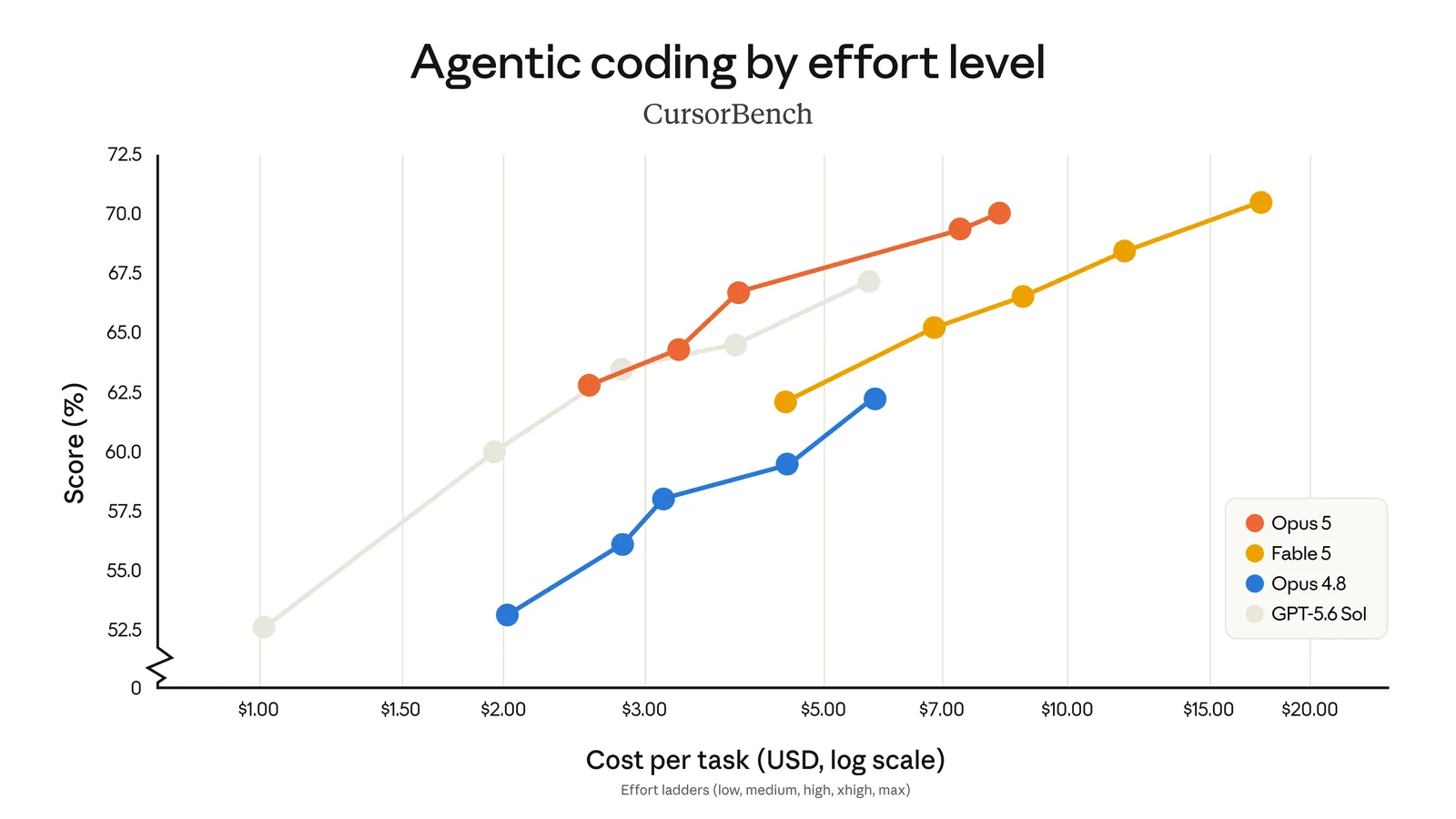
CursorBench 3.2: ~0.5% gap, ~half the cost
At max effort, Opus 5 sits within ~0.5% of Fable 5’s peak while costing about half per task. Higher is better; further left is cheaper — orange is Opus 5.
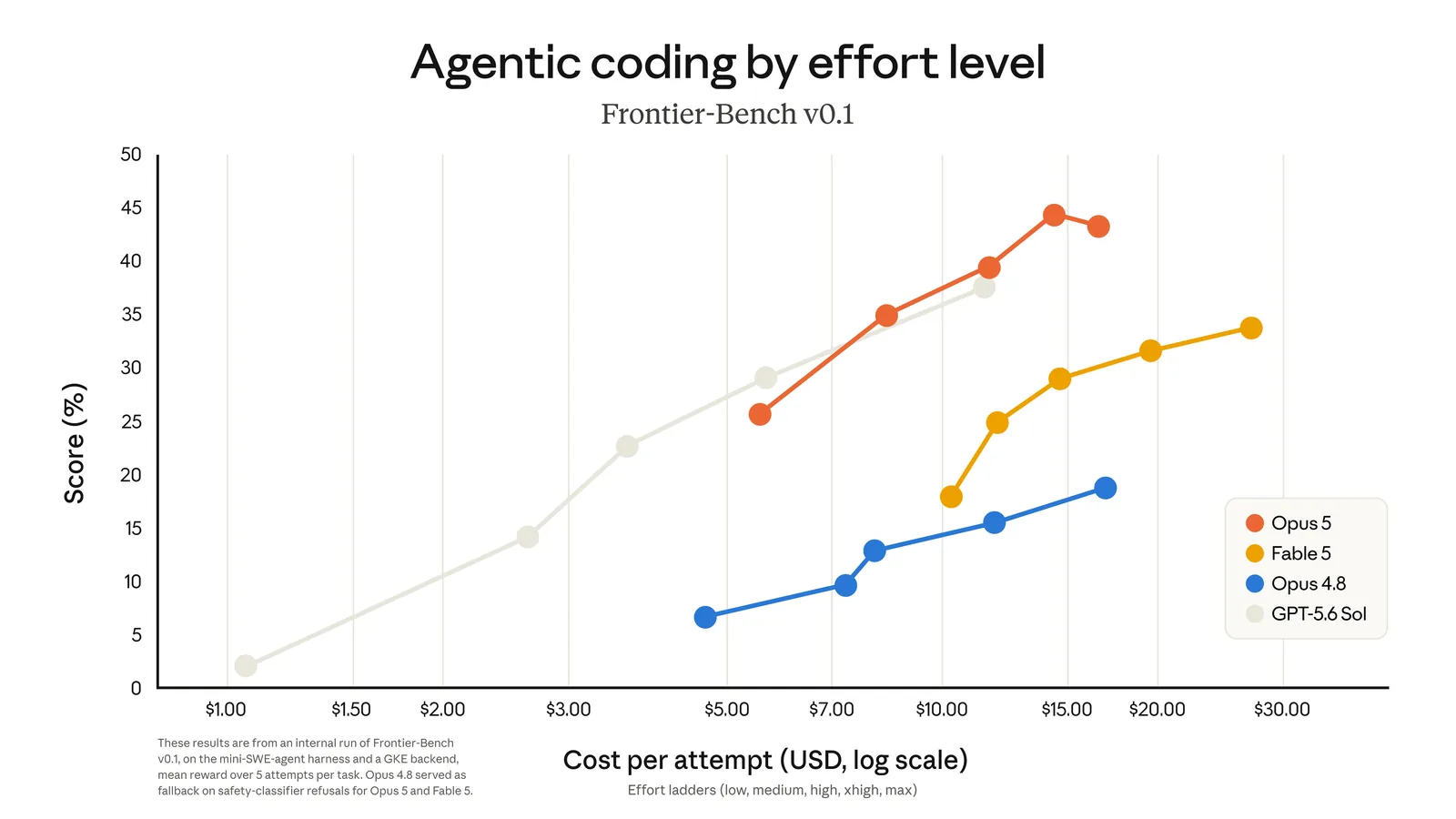
Frontier-Bench: hard software engineering
Anthropic says Opus 5 surpasses all models here and more than doubles Opus 4.8 at lower cost per task. Versus Fable, the win is often “same budget, further up-left.”
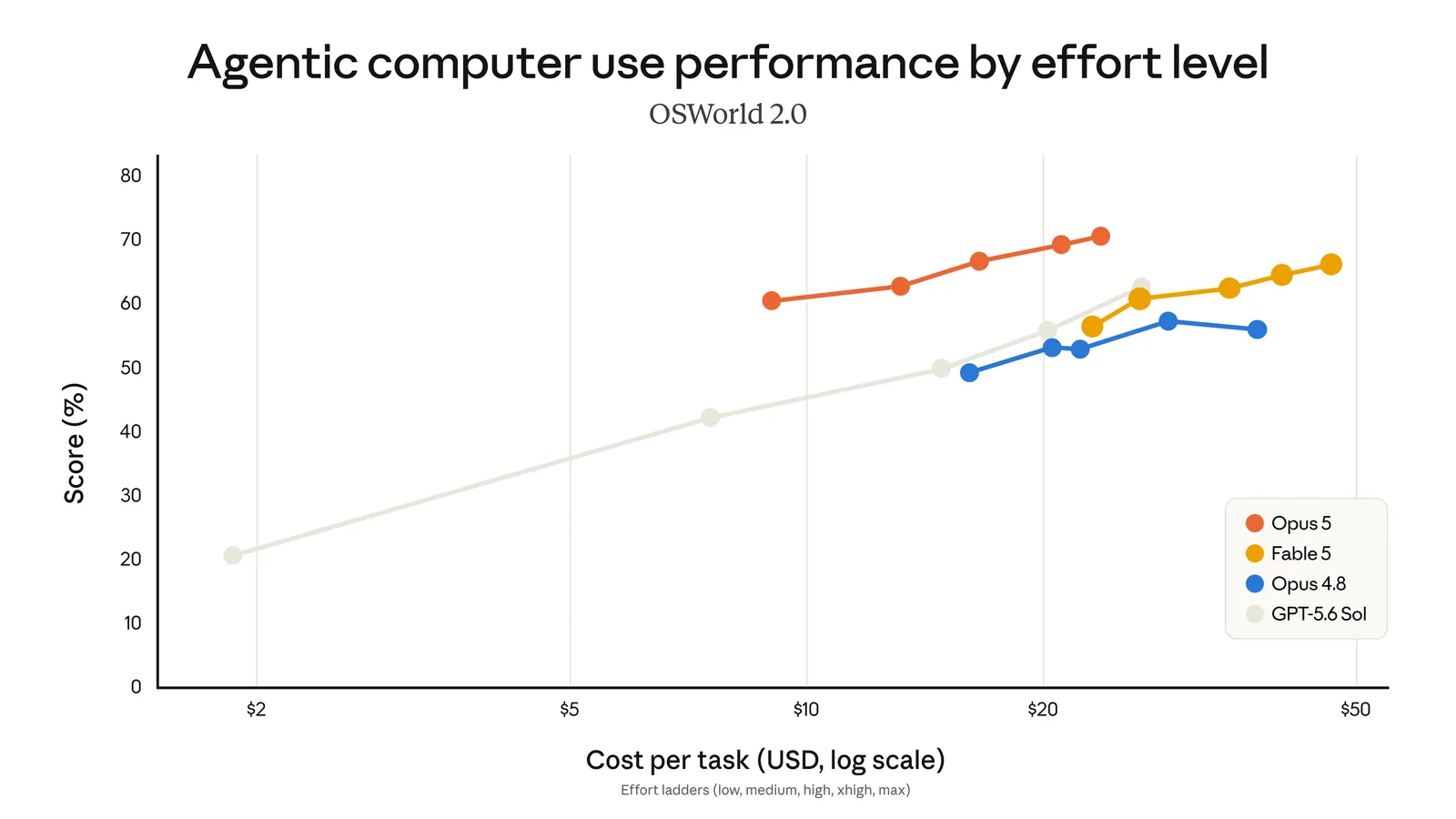
OSWorld 2.0: computer-use agents
Click, type, finish workflows. Official claim: Opus 5 leads at any given cost and can beat Fable 5’s best at roughly one-third the spend.
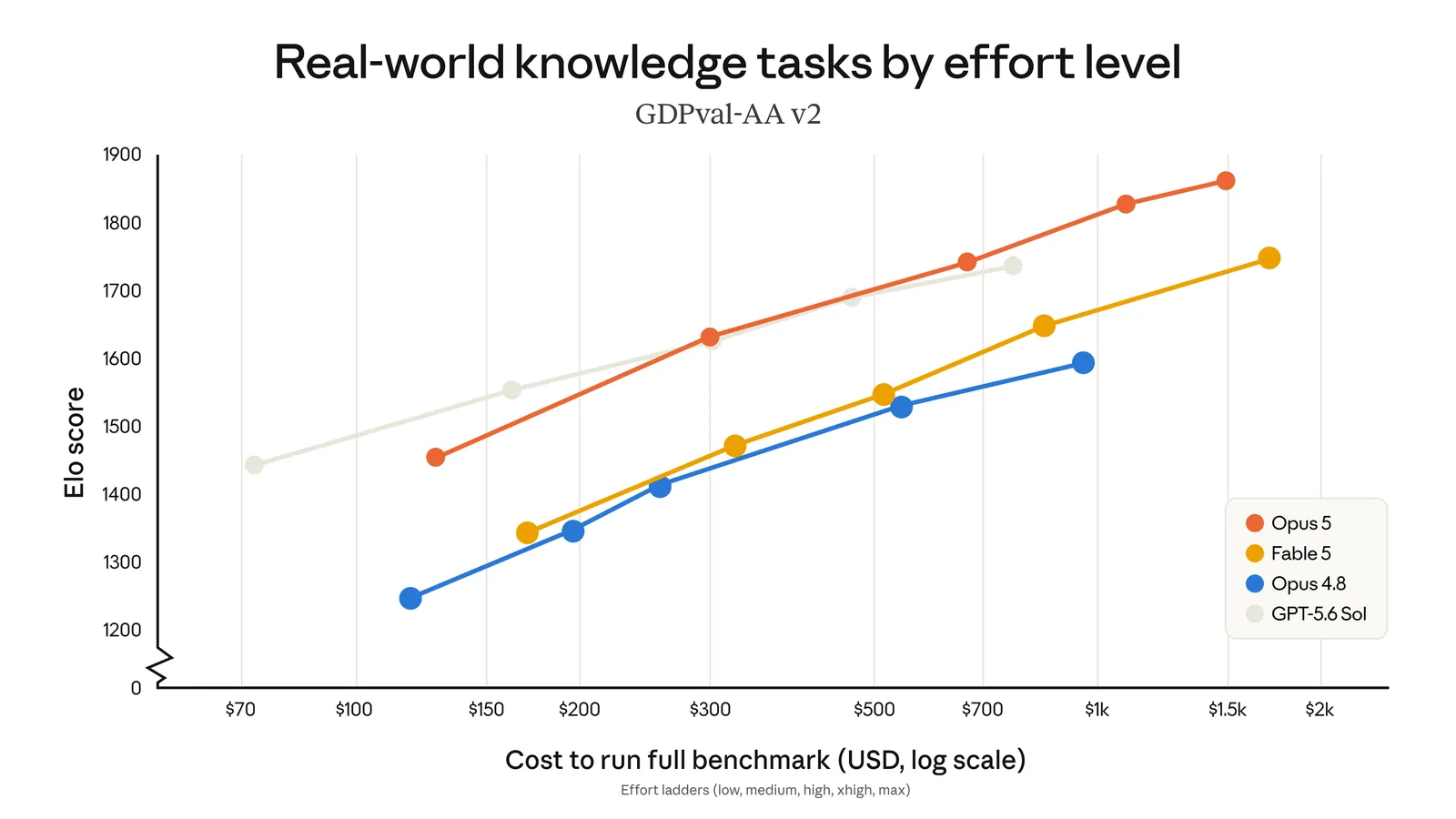
GDPval-AA: knowledge-work SOTA narrative
Analyst-style work. Opus 5 is framed as a new bar for knowledge tasks — research, tables, reports — where it’s often the better everyday buy.
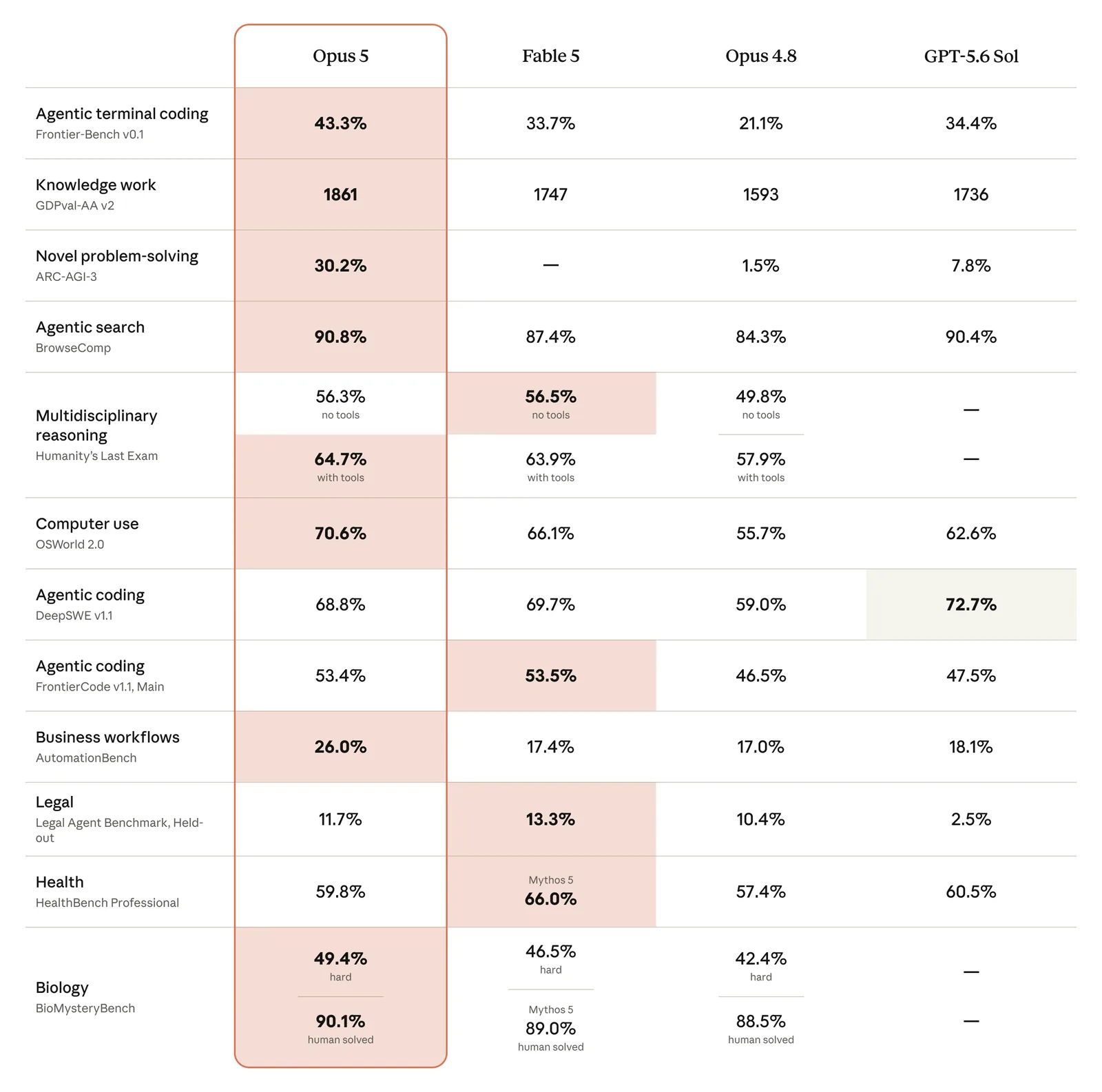
Official summary table
Anthropic’s overview table for Opus 5 vs Fable 5, Opus 4.8, and peers. Use it for magnitude, then dive into single charts.
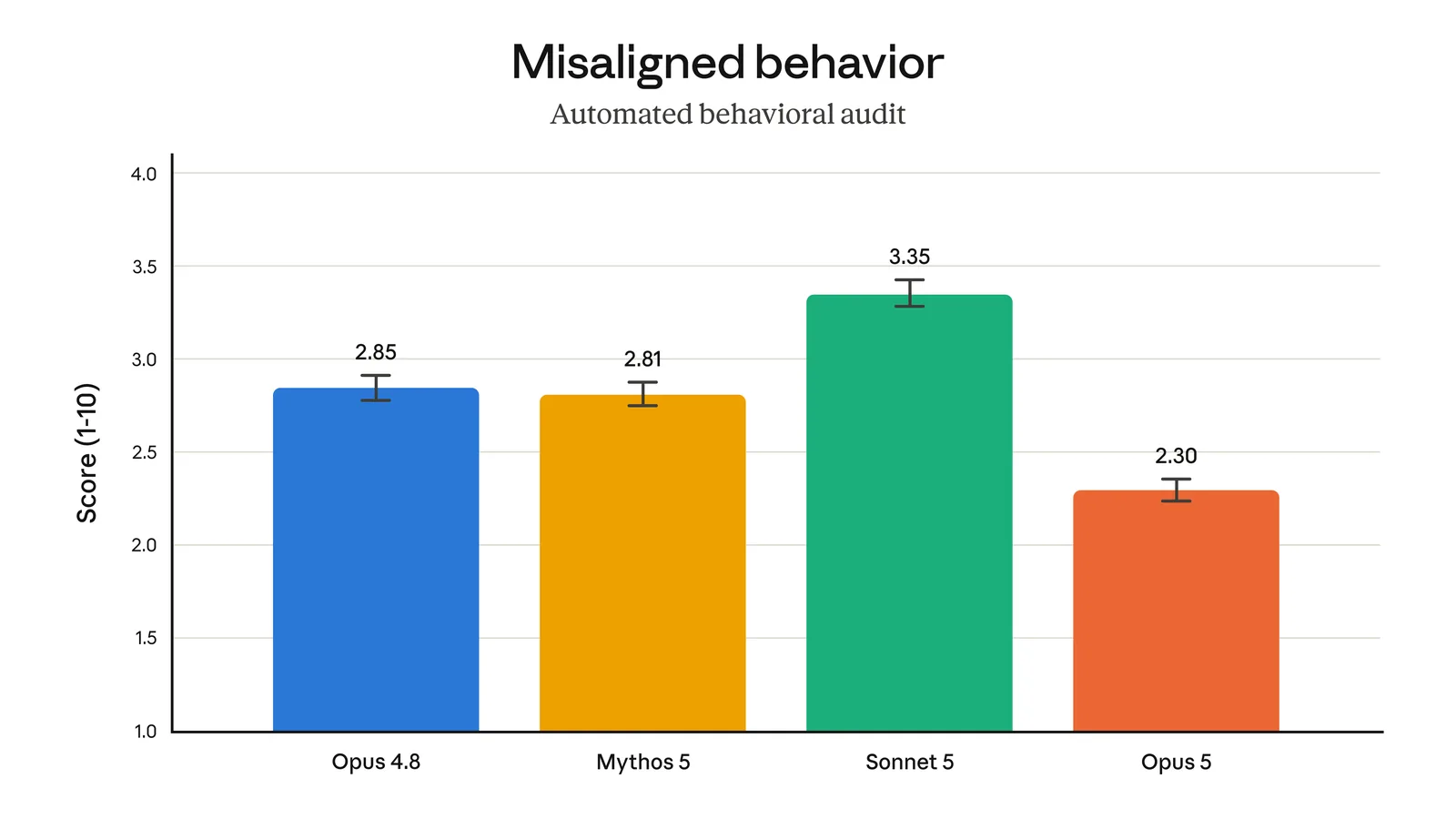
Alignment audit: Opus 5 steadier
On the behavioral audit, Opus 5’s misalignment score is lower than several recent models (including Fable 5). Another reason to default to it day to day.
Charts and full notes: Anthropic announcement · Claude Fable product page · official pricing. Independent plain-language summary — not affiliated with Anthropic.
Playbook
Think tool tiers: Opus 5 is the daily drill; Fable 5 is the industrial machine you switch on rarely.
Heavy Cursor / Claude Code use. CursorBench nearly peaks while you pay Opus rates — why Anthropic made it the Max default.
Reports, tables, multi-step Zapier-style flows, research. GDPval / AutomationBench narratives favor “stronger at the same spend.”
API list price is exactly half of Fable ($5/$25 vs $10/$50). Agent loops and batch jobs turn half-price into roughly 2× headroom.
Hardest research, highest-stakes decisions, or internal evals that prove Fable’s extra half-point is worth paying for.
If workflows are designed around Fable quotas and failure is extremely expensive, keep Fable for that lane — put the rest on Opus 5.
OSWorld: official story is lower cost to match or beat Fable’s peak — strong for agents that click through a whole flow.
FAQ
On Anthropic’s public API rates: Opus 5 is $5 / $25 per MTok; Fable 5 is $10 / $50 — exactly half. Subscription credit multipliers may differ; use the API card for clean apples-to-apples.
Peak models serve “must squeeze the limit” workloads. Opus 5 is the everyday near-peak option — most people get close enough at half price; a minority still pays full freight.
Opus 5 is the same list price as 4.8, but Anthropic says it jumps hard on Frontier-Bench-style coding (e.g. ~2× performance, lower cost/task). Upgrading 4.8→5 is usually “same bill, clearly stronger” — no need to jump to Fable first.
Open the hub at /claude-opus-5 (or claudeopus5.top for this language), or read the official announcement.
Next